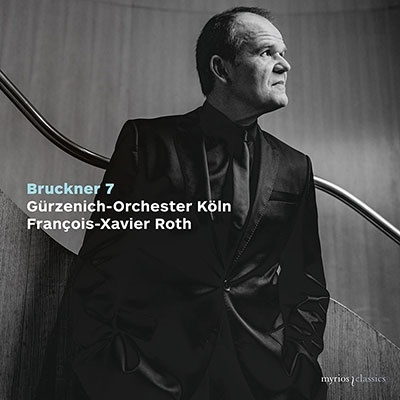
2024年のブルックナー・イヤーに向け
ロト&ギュルツェニヒの交響曲全集シリーズ開始。
第1弾は7番!
大活躍のロトがケルン・ギュルツェニヒ管弦楽団とブルックナーに挑戦しました。2024年のブルックナー生誕200周年に向けた交響曲全集シリーズの第1弾で、まず第7番がとりあげられました。
ロトはブルックナーを「モダニズムの先駆者」とみなしていて意欲満点。ヴァントが長年育んだブルックナーの交響曲伝統を持つギュルツェニヒ管との共演は伝統と革新がないまぜとなり新しいブルックナー像を作り上げるはずと申せましょう。
各楽章の演奏時間はI. 18:17" II. 18:15" III. 8:59" IV. 11:10"で、一般的な演奏よりかなり速いことがうかがえます。いつものロトらしくアプローチは無駄がなく、フットワークも軽く常に透明な響きに満ちているのがブルックナーの交響曲としては新鮮に聴こえます。
ライヴ録音ですが、ハイレゾDXD処理された高音質サウンドも注目。オーディオファンにもオススメです。
キングインターナショナル
発売・販売元 提供資料(2021/12/06)
The approach of the Bruckner bicentennial in 2024 has brought forth performances of the composers symphonies from the likes of the Staatskapelle Dresden and the Vienna Philharmonic; orchestras with these works in their bones. The Gurzenich-Orchester Koln does not have quite such a long history with Bruckner, but its a venerable organization that can produce fine results when challenged to do so. Its thus welcome news that the group and its conductor Francois-Xavier Roth have launched a Bruckner cycle of their own. Without trying to compete with a technician like Christian Thielemann, Roth carves out a distinctive space in the Bruckner universe. One might not have expected this from a conductor who began his career in the world of historically oriented Baroque music performances, but he has emerged as a major interpreter of Mahler, Strauss, and now Bruckner. His is a Schubertian, echt-Viennese Bruckner, quicker than average at under 57 minutes and emphasizing a flowing quality rather than heroics. The work, and especially its Adagio slow movement, is often taken as an elegy for the recently deceased Richard Wagner, but annotator Volker Hagedorn points out that much of the famous Adagio had already been written when Wagner passed away; he suggests as an alternate motivation, the catastrophic Ringtheater fire of 1881 in Vienna, to date the worst theater fire in history. Bruckner lived down the street from the theater but elected not to attend on the night of the fire. This Adagio in Roths hands is marvelous, almost spiritual. It is unusually quick and is a kind of apotheosis of the dance in which the Gurzenich strings rise to the occasion in matching Roths momentum. The finale here is not so triumphal as others, but the performance throughout is a delicate one that captures a great deal of Bruckners detail. The Myrios Classics sound, recorded live in the Kolner Philharmonie in 2019, reminds the listener that the hall is one of Europes finest for late Romantic orchestral music. One awaits further installments in the cycle with great interest.
Rovi