リストが描いた聖人にまつわる音物語
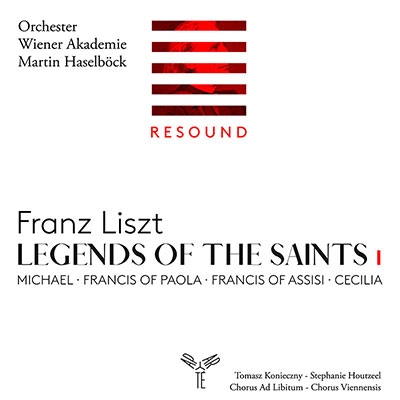
「聖人の伝説」集
ハーゼルベック指揮、ウィーン・アカデミー管による、リストのシリーズがスタートします。1865年に僧籍に入ったリストは、キリスト教を題材とした作品を多く書くようになります。そして、ほかの作曲家にはあまり例をみませんが、絵画や書物から題材をとった、聖人にまつわる音楽を多く書いています。ここでは、「聖人の伝説」として、キリスト教上の様々な聖人にまつわる物語を音楽にした作品をシリーズとしてお届けします。第1弾は、聖チェチリア((2))、ふたりの聖フランチェスコ(《2つの伝説》(3))などが取り上げられています。
リストが交響詩を多く書いたのは1850年でした。1862年頃の《2つの伝説》はピアノ版でも広く知られる作品ですが、ピアノ版とこの管弦楽版、どちらが先に完成したかについては定かになってはいません(ピアノ版とは順序が逆になっています)。ピアノ版でも既に豊かな情景に満ちた音楽ですが、交響詩などと比べても遜色ないクライマックスの見事な演出など、管弦楽版ならではの魅力に満ちています。「小鳥」の音色を管楽器で奏でたりと、より一層豊かな色彩感をもって、聖フランチェスコが説教するシーンが響きます。
ほかにも、アッシジの聖フランチェスコが自然を讃えた祈り「太陽の讃歌」に基づいた《アッシジの聖フランチェスコの太陽の讃歌》を収録。バリトン・ソロを務めるのはバイロイト音楽祭や東京・春・音楽祭などでもおなじみのトマシュ・コニエチュニ。《ストラスブール大聖堂の鐘》では、まるでワーグナーを思わせる管弦楽と合唱をバックに、力強くもドラマティックな歌声を聴かせます。演奏会用小品の《ホザンナ》など、演奏機会の少ない作品が収録されております。
ハーゼルベックの指揮が導く音楽が非常にドラマティックにして敬虔な空気に満ちており、教会の荘厳な空気までをも伝えてくれるようです。
ハーゼルベックはオルガン奏者、指揮者として数多くのリリースと受賞を重ねた重鎮。1985年にピリオド楽器のウィーン・アカデミー管弦楽団を設立し、バロックからロマン派作品まで、ウィーン楽友協会および世界中で演奏会シリーズを重ねました。
キングインターナショナル
発売・販売元 提供資料(2023/03/08)
Liszts sacred works as a group remain almost completely unknown, even though he wrote a lot of it, was devoutly religious for the second half of his life, and eventually became a monk. He wrote some 50 Latin motets, masses, oratorios, and choral-orchestral pieces like the ones on this 2022 release by the Orchester Wiener Akademie. Promotion for the album asserts that they "[bear] little resemblance to Liszts secular compositions," and while thats true enough, one might easily guess him as the composer. There is a lot of counterpoint, but the imposing Lisztian hyper-expressivity is there. Arguably the most interesting are the titular Legends of the Saints, with their programmatic writing. The second of the Deux Legends, S. 354, Saint Francois dAssise, la predication aux oiseaux ("Saint Francis of Assisi, Preaching to the Birds"), could easily be programmed with one of Olivier Messiaens works referring to birds. Many of the pieces have a part for organ, and there is one organ solo, San Francesco, S. 665. The final Hosannah, S. 677, with its organ-brass interplay, would make a fine replacement for or complement to holiday-season Mendelssohn. The Orchester Wiener Akademie and conductor Martin Haselbock have been recording Liszts music on historical instruments and rediscovering a good deal of obscure music in the process, and this is all to the good. The period strings have some guts to them (no pun intended), and the performances, with a smaller ensemble that has been heard in the rare instances where this repertory has been recorded previously, have a lot of detail coupled with immediacy and warmth. The soloists -- bass-baritone Tomasz Konieczny and mezzo-soprano Stephanie Houtzeel -- are ideal. This is an unusually satisfying recording that will be essential for Liszt buffs and is enjoyable for anyone. ~ James Manheim
Rovi